The destination guide
Hiriketiya Beach, Sri Lanka
A small horseshoe bay near Dikwella on Sri Lanka's south coast, known for beginner-friendly surf, sheltered swimming and a slow village pace.
Explore the guide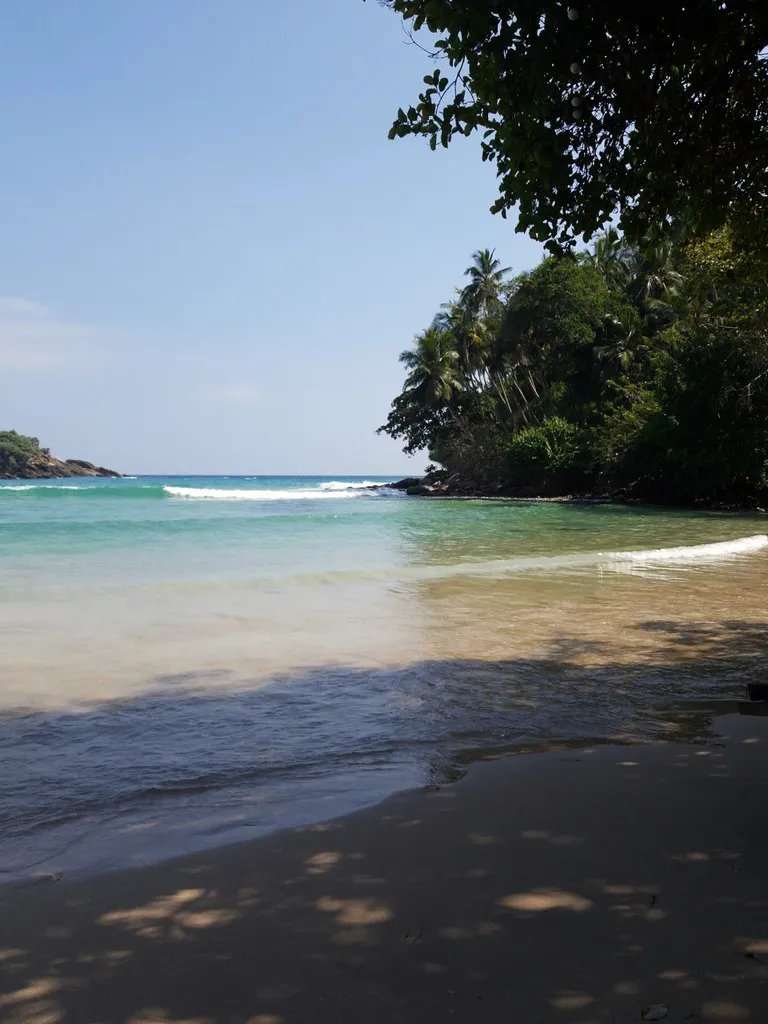
 By Ashan LokugeUpdated
- Best time to go
- December to March
- Make time for
- 2 to 4 nights, longer if you are learning to surf
- Perfect for
- Beginner and intermediate surfers, couples and slow travellers
On This Page
Why Visit Hiriketiya
Hiriketiya Beach is a small, deep bay on Sri Lanka's south coast, a couple of kilometres east of Dikwella town in Matara District. Two jungle-covered headlands wrap around a short curve of sand, which is why people describe it as horseshoe-shaped, and why the water inside is calmer than on the open coast. It is the bay itself that people come for: you surf it, swim in it and spend the evening on the sand watching the last sets roll in.
Not long ago this was a sleepy surf spot reached by potholed tracks. Lonely Planet's surfing guide (opens in a new tab) describes how it has grown into "a buzzy beach town", with busier line-ups, coffee shops and guesthouses, while still calling it "among the best bases for learner surfers" in the country. The village has kept a low-rise feel: villas and guesthouses climb the hill behind the beach and over towards Dikwella rather than lining the sand with big hotels. The building has not stopped: in late 2025, Scott and Lynn of Travelling Planet Earth found new cafés, guesthouses and a large beach club going up along the lanes and over the hill towards Dikwella, so the village keeps changing from one season to the next.
Hiriketiya suits travellers who want a slower few days between the busier stops of a south coast trip. Most visitors pair it with Mirissa, Galle or Tangalle, and it fits neatly at the end of a loop that comes down from the hills. If you are still working out how the coast fits into the rest of your trip, our Sri Lanka itinerary planner shows how many nights each stop usually gets.
Surfing In Hiriketiya
The two headlands split the incoming swell into different waves, which is what makes the bay work for mixed groups. On the western side there is a sand-bottomed beach break, a gentle wave where most surf schools take beginners. Towards the middle, peaks break over a deeper rock reef. Off the eastern headland a fast left-hand reef break runs along the rocks; it is a wave for confident intermediate and advanced surfers, and the rocks underneath are covered in sea urchins.
The main surf season on the south coast runs from November to April, when the northeast monsoon brings offshore winds to this side of the island. December and January tend to bring the better waves for intermediate surfers, while February is usually smaller and kinder to beginners. Early mornings are generally best, before the wind picks up, and also before the line-up fills; the bay is now popular, so expect company on good days. Be ready for company: by 7am in season the surf schools are already out, and on a busy morning there can be a couple of hundred boards in the water, most of them learners on the small inside waves. If you rent a board, check it for dings before you paddle out, because the shop will check it when you bring it back.
Lessons are easy to arrange on the beach. Time Out counted nearly a dozen surf schools (opens in a new tab) in 2025, charging roughly LKR 5,000 to 6,000 for an hour's lesson with a board. In April 2026, Team Sauce Travels' May 2026 video of Hiriketiya found the going rate was about LKR 6,000 for a 90-minute lesson and LKR 1,000 an hour to rent a board; Jumping Places paid the same board rate in December 2025, the same as in Weligama. Prices change with the season, so treat these as a guide rather than a quote.
Swimming And Safety In Hiriketiya
The beach itself is short, only about 200 metres from end to end, and on calm days there is a shallow stretch where you can wade out a long way without being knocked about by the waves. Because the bay is so enclosed, swimming is usually easy here, and Rough Guides notes (opens in a new tab) that you can often still swim or surf between May and October, when much of the south coast is rough. That said, it is the open Indian Ocean, and conditions change quickly. The water is usually very clean. Behind the beach there is a small lagoon, and every so often a channel is dug to flush it into the bay; give that spot a miss while the water is running out.
- Swim inside the bay, away from the surfers on the reef and the rocks below the headlands.
- Watch for sets that close out across the beach break, and do not swim near the eastern point, where the reef and urchins sit just under the surface.
- We have not found any record of a lifeguard post at Hiriketiya, so swim where others are swimming and ask a surf school about the day's conditions.
- From May to September the southwest monsoon brings rain and heavier seas to this coast, according to Sri Lanka Tourism's weather guide (opens in a new tab). Take more care in those months, even in the bay.
Things To Do In Hiriketiya
Most days here revolve around the water, but there is plenty within a short tuk-tuk ride. Two of the best nearby spots have their own guides.
Blue Beach Island
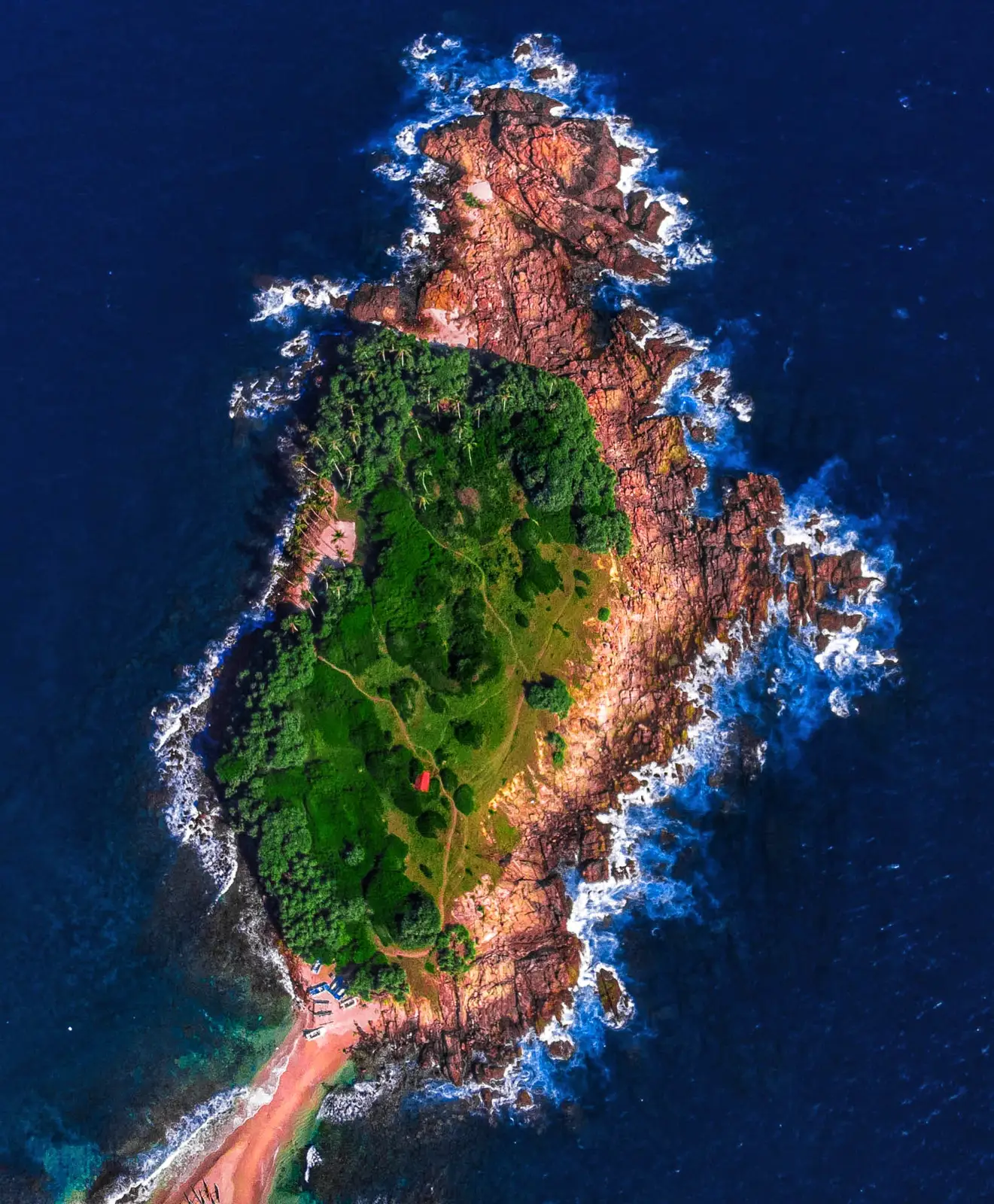
A rocky little island off Nilwella that you can walk out to across a sandbar when the tide is low.
About 2 km away · Go at low tide · 1 to 2 hours
Photo: KingAlawaka, CC BY-SA 4.0, via Wikimedia Commons
Dickwella Beach
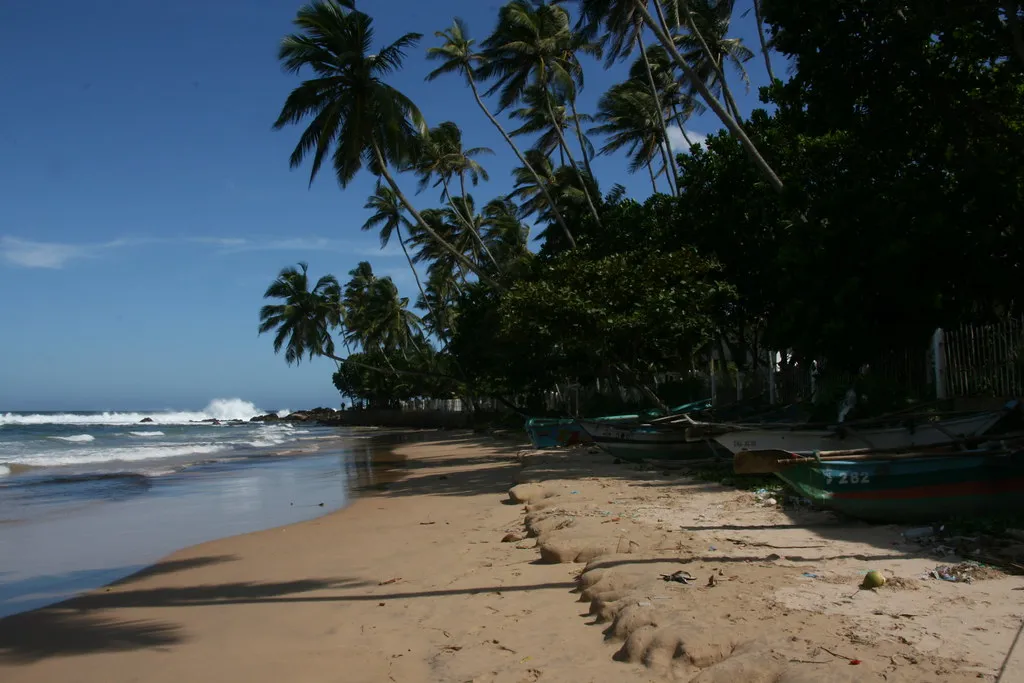
The long sandy bay next door, sheltered by headlands and reefs, with fishing canoes at its eastern end.
15-minute walk · Calmer swimming · Half a day
Photo: Marco Zanferrari, CC BY-SA 2.0, via Flickr
Take A Surf Lesson Or Just Watch
Even if you never stand up on a board, an early morning on the sand watching the surf schools at work is a good way to start the day. Most schools teach in short sessions in the morning, when the water is calmest; ask what is included before you book.
Yoga, Wellness And Gyms
Alongside the surf schools, Hiriketiya has a healthy-living scene that suits longer stays. There are several yoga studios and shalas, a wellness café with a sauna and ice bath, and massage places that regulars rave about, so ask around for whoever is currently recommended. If you want to keep training, there is a small gym with new equipment, an older gym near Dickwella Beach and an open-air calisthenics gym with wooden weights. None of it is big or polished, but it is enough to keep a routine going between surfs.
Sunset Drinks And Evenings
Evenings start early here, with everyone drifting to the sand or the hillside bars to watch the last surfers of the day. Bars on the slopes above the bay have elevated views and DJs at sunset, and the best seats go quickly in season, so book ahead. On the Dickwella side there are small, quieter beach bars. Hiriketiya is a relaxed place rather than a party town, though a few venues host livelier nights in the high season. Because the bay is wrapped in headlands, you will not see the sun drop into the sea from the main beach; it sets behind the land and colours the sky over the point instead. For a sunset over open ocean, walk about 15 minutes up and over the hill to Dickwella Beach, where a few small beach bars look out to sea.
Wewurukannala Vihara
A short tuk-tuk ride inland, near Dikwella, this temple is known for its giant seated Buddha statue, one of the largest in the country. It is an easy hour's visit on a rainy afternoon, and our Dickwella Beach guide covers the temple in more detail. In April 2026 the big statue was covered for renovation work, so check before you go if seeing it is the main reason for the trip. Dress modestly, with shoulders and knees covered.
Hummanaya Blowhole
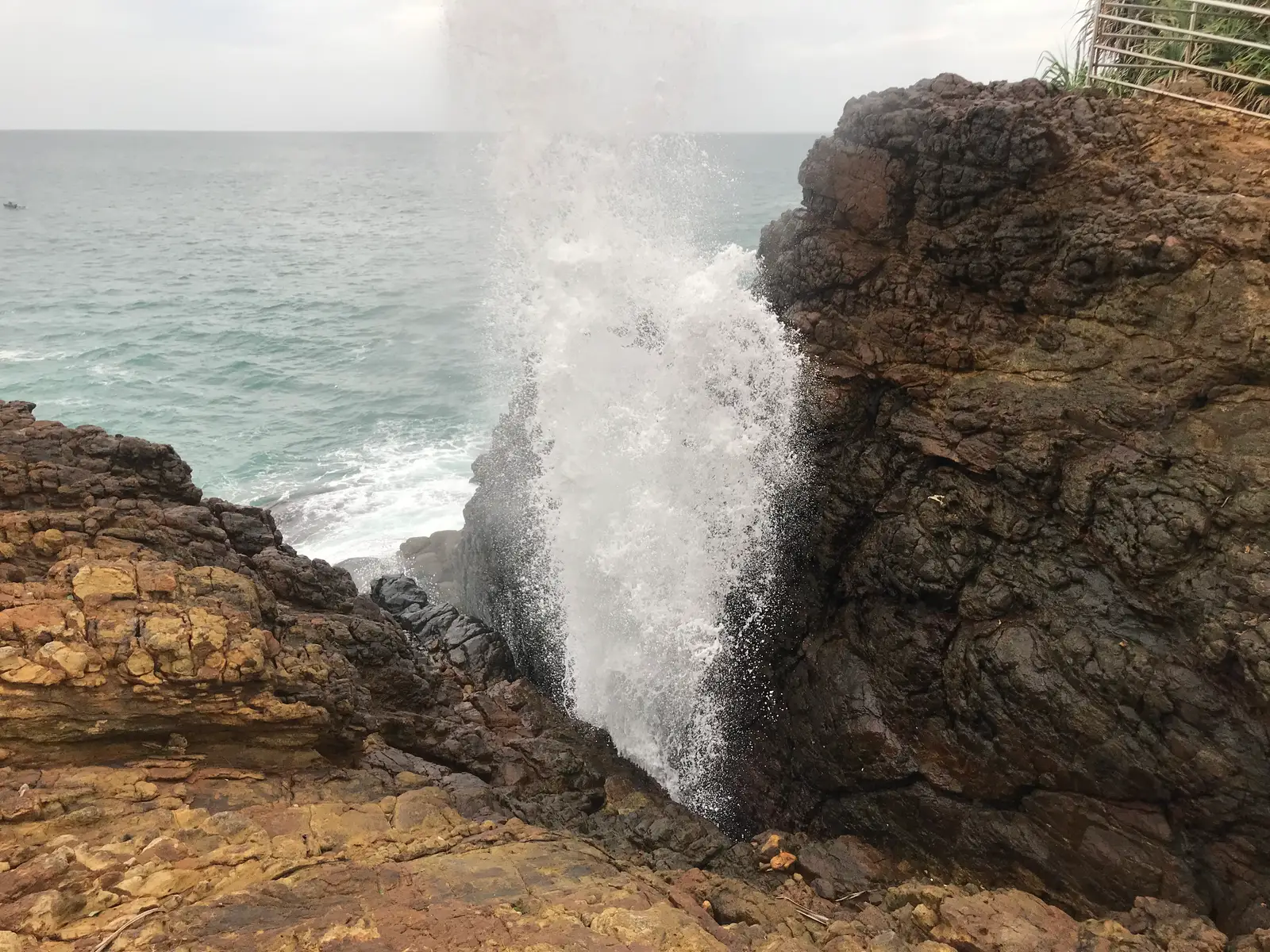
About 6 km east of the bay by road, near Kudawella village, the Hummanaya blowhole fires sea spray high into the air through a gap in the rocks, most dramatically when the swell is big. It is just over the border in Hambantota District and makes an easy half-day trip with Blue Beach Island on the way.
Turtle Watching At Rekawa
Rekawa beach, about 10 km beyond Tangalle and roughly 35 minutes from Hiriketiya by car, is home to a long-running community turtle conservation project that guards the nesting beaches. Visits are run by the local project, which keeps visitors at a respectful distance from nesting turtles.
Whale Watching From Mirissa
Whale-watching boats leave from Mirissa harbour, about 45 minutes west by road, and the calm dry-season months are the usual time to go. Most trips leave very early, so it is easier to stay in Mirissa the night before.
Where To Stay In Hiriketiya
Accommodation in Hiriketiya is small-scale. Expect guesthouses, villas and surf camps rather than large resort hotels, and plan to book ahead between December and March, when the bay is at its busiest. Many villas can be booked as a whole house or by the room, and family-run homestays, often with a home-cooked breakfast, are the most affordable way to stay close to the bay. Scheduled power cuts still happen now and then, sometimes for most of a day, so if you need to work online, ask whether your stay has a generator or backup power.
- On the bay. A handful of places sit right behind the beach. You will hear the waves at night and can walk straight into the water, but rooms here are the most sought after.
- On the hill and the lanes behind the beach. Most guesthouses and villas are a few minutes' walk up the slope, often with sea views and a little more quiet.
- Towards Dikwella. The road over the western hill leads to Dikwella's long bay, with more space and a wider choice of stays. It is quieter than Hiriketiya, its calm beach suits families, and from the nearest stays it is only a 5 to 15-minute walk into Hiriketiya.
- Surf camps. Several camps package a room, meals and daily lessons, which suits anyone coming mainly to learn to surf.
Where To Eat In Hiriketiya
Food in Hiriketiya is relaxed and mostly within a few minutes' walk of the beach. Cafés near the bay serve breakfasts and coffee for the post-surf crowd, and in the evening a few beach restaurants put tables on the sand. For local food, rice and curry lunches and fresh seafood are easy to find, and Dikwella town has bakeries and simple local restaurants.
A few local things are worth trying while you are here. In the mornings, look out for kola kenda, a traditional herbal porridge made from rice, coconut milk and green leaves. Egg hoppers, the bowl-shaped rice pancakes with an egg cooked in the middle, are a classic breakfast. Buffalo curd is sold at roadside stalls in clay pots and is eaten with treacle. Lunchtime rice and curry at a small local restaurant is the best-value meal in the village, and there is a gelato shop with a devoted following for the afternoon heat.
As a rough guide, main dishes at the beachside restaurants cost about LKR 2,300 to 2,800 in December 2025 (a pizza, a rice and curry or a burger), a café brunch for two with coffee came to about LKR 7,000 in April 2026, and dinner for two at a restaurant overlooking the surf about LKR 3,500. In the busy season the most popular places fill up, so book dinner ahead through their Instagram or WhatsApp, and expect slow kitchens at peak times. Around Sinhala and Tamil New Year in mid-April many local restaurants close for a few days, while the tourist cafés usually stay open.
It helps to know the two roads. Hiriketiya Road on the western side has most of the bigger, trendier cafés and restaurants, while Hiriketiya Beach Road on the eastern side is quieter, with smaller and cheaper cafés serving rice and curry and hoppers, plus budget hostels. On the main road into the beach a few street stalls sell kottu and roti, hoppers and fresh juice; in November 2025 a roti brunch for two with a soft drink cost about USD 5. Down on the sand a food truck puts out tables for an easy lunch or dinner.
Vegetarian travellers, including many visitors from India, will find it straightforward: rice and curry is often vegetable-based, and most cafés list vegetarian and vegan dishes. Ask for less chilli if you prefer milder food.
Getting To And Around Hiriketiya
Hiriketiya sits about 200 km from Bandaranaike International Airport and about 175 km from Colombo. The quickest route is the Southern Expressway (E01), which runs past Matara towards Hambantota, followed by a short drive down to the coast near Dikwella.
- By private car and driver. The simplest option, especially straight from the airport. Allow roughly 3 to 3.5 hours from the airport and 2.5 to 3 hours from Colombo, depending on traffic. Our private driver service in Sri Lanka lists vetted drivers, and an airport taxi from Colombo airport works well for a direct transfer.
- By train. The coastal railway now runs beyond Matara to Beliatta, and Wewurukannala station is a few kilometres inland from the bay, a short tuk-tuk ride away. Schedules change, so check departures before you travel; our guide to getting around Sri Lanka compares trains, buses and drivers.
- By bus. Buses run from Colombo and other south coast towns to Dikwella, and the highway bus timetable lists the expressway services. From Dikwella, a tuk-tuk to Hiriketiya takes under 10 minutes.
- From Mirissa, Weligama and Galle. Mirissa is about 33 km west, Weligama about 38 km and Galle about 66 km. Allow 45 minutes to an hour from Mirissa, around 50 minutes from Weligama and 1 to 1.5 hours from Galle: the coast road is winding and slow, with plenty of tuk-tuks, scooters and dogs to pass.
Distances and drive times on this page are our estimates from mapping data, and real journeys vary with traffic.
Getting around locally is easy, and once you are in the village you can walk almost everywhere: the bay, the cafés and the lanes behind the beach are all within a few minutes of each other. For anything further, tuk-tuks can be waved down in the village and in Dikwella, and the ride-hailing apps Uber and PickMe both work along this coast; prices between the two can differ by LKR 1,000 or more on the same trip, so compare both before you book. Scooters are easy to rent, at around LKR 2,500 a day in April 2026, but you need your home licence for a motorbike plus the right Sri Lankan permit to ride legally; our guide to the documents needed to rent a vehicle in Sri Lanka explains what to bring, and the bay itself is small enough to walk end to end in a few minutes. Everything in the village is within a 10 to 15-minute walk, and traffic is light. A footpath past the lagoon links Hiriketiya Road and Hiriketiya Beach Road, a handy shortcut where you will often see monkeys, squirrels and the odd large monitor lizard.
Best Time To Visit Hiriketiya
The best time to visit Hiriketiya is from December to March, when the south coast is in its dry season, the sea is calm and the surf is at its most beginner-friendly. April is more mixed, hotter and less settled. The southwest monsoon arrives in May, the wettest month of the early season; from June to September there are showers and bigger seas, although the sheltered bay often stays swimmable. October and November are usually the wettest months of all. Even in the dry season, a heavy shower can roll through and clear within the hour, so a grey morning rarely ruins the day.
| Month | Conditions in Hiriketiya |
|---|---|
| January to March | Best: dry, sunny and calm, with the most consistent beginner surf |
| April | Mixed: hot, with more afternoon showers |
| May | Wet: start of the southwest monsoon |
| June to September | Mixed: showers and bigger seas, though the bay is often still swimmable |
| October to November | Wet: the wettest stretch of the year |
| December | Best: the dry season returns and the main surf season gets going |
For the whole island month by month, see our guide to the best time to visit Sri Lanka.
Places Near Hiriketiya
Hiriketiya makes a good base for the eastern half of the south coast.
- Dikwella (about 1.5 km): the local market town, with banks, shops and buses. Its Saturday market is the best time to see it busy.
- Tangalle (about 15 km): long, quiet beaches, a fishing harbour and the base for Rekawa turtle watching; it feels less touristy than Weligama or Mirissa.
- Mulkirigala rock temple (inland from Tangalle): cave temples with reclining Buddhas and old murals, climbing a rock where monks have lived for more than 2,000 years; entry was LKR 500 per person in December 2025, and few foreign visitors make it here.
- Mirissa (about 33 km): whale watching, a lively beach strip and more nightlife.
- Weligama (about 38 km): a wide, gentle bay that is another popular place to learn to surf.
Hiriketiya Beach FAQs
Is Hiriketiya Good For Beginner Surfers?
Yes. The sandy beach break on the western side of the bay is one of the gentlest waves on the south coast, and nearly a dozen surf schools offer lessons there. The reef break off the eastern headland is for experienced surfers only.
When Is The Best Time To Visit Hiriketiya?
December to March is the best time, with dry weather, calm seas and reliable beginner waves. Surfers count the season as November to April, but November is often still wet, so December onwards is the safer bet. May to September is the southwest monsoon, when the coast is wetter and rougher.
Is It Safe To Swim At Hiriketiya?
The bay is sheltered and usually calm enough for swimming, especially in the dry season. Keep away from the reef and rocks under the headlands, watch out for surfers, and take more care during the monsoon. We have not found a record of a lifeguard post, so ask locally about the day's conditions.
How Do I Get To Hiriketiya From Colombo Or The Airport?
The fastest way is by car on the Southern Expressway, which takes about 2.5 to 3 hours from Colombo and 3 to 3.5 hours from the airport. You can also take the train to Wewurukannala, a few kilometres inland, or a bus to Dikwella and a short tuk-tuk ride from there.
How Far Is Hiriketiya From Mirissa?
About 33 km. Allow 45 minutes to an hour by car, and longer by tuk-tuk, because the coast road is winding and busy. Many travellers stay in both, using Mirissa for whale watching and Hiriketiya for surfing and quieter days.
Is Hiriketiya The Same As Dikwella?
Not quite. Hiriketiya is a small bay just east of Dikwella town, and both are in Matara District. Dikwella has its own, much longer beach, and the two are a 5 to 15-minute walk apart around the headland, depending on where you start.
How Many Days Should I Spend In Hiriketiya?
Two to four nights is enough for most travellers to surf, swim and visit Blue Beach Island and the blowhole. If you are learning to surf, a week of daily lessons makes a real difference.